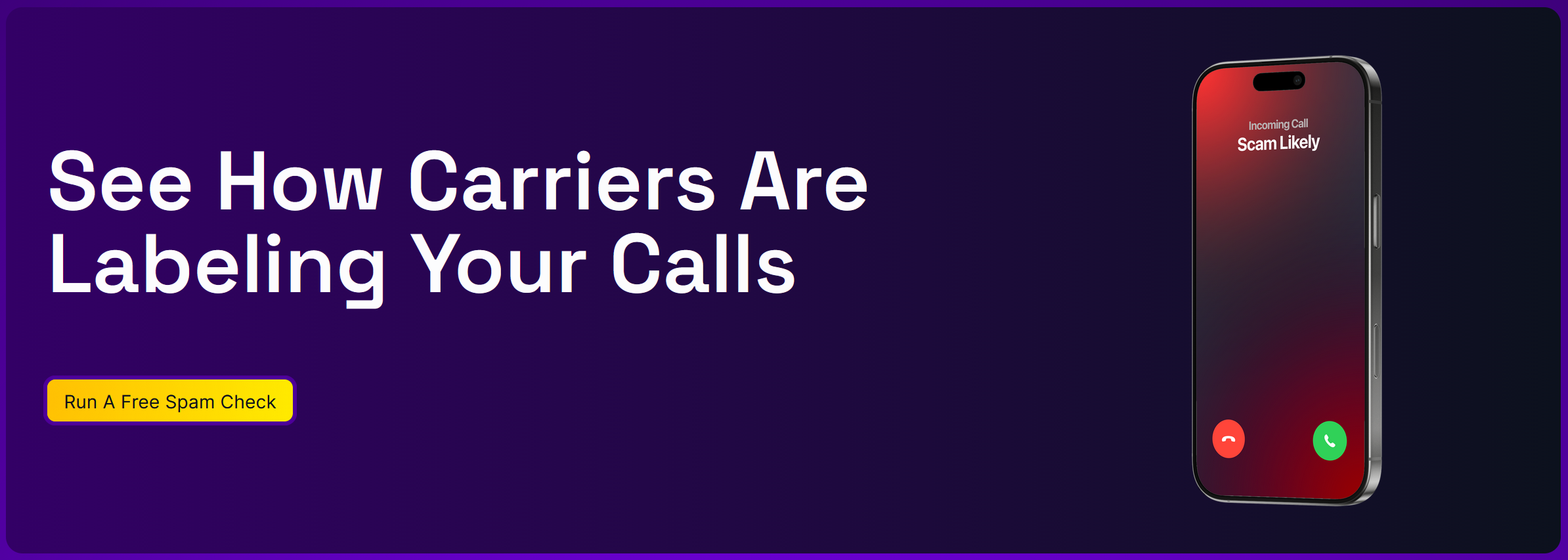
Calling a single device to see what appears on the screen is not an accurate way to check for spam flags or warning labels. Flags and CNAM information do not appear consistently across different carriers or devices, so one test can miss real problems. Reliable testing tools like ARMOR®’s free spam flag checker place calls to devices used by real subscribers across different networks to verify how your number appears, with screenshots to confirm whether spam labels are affecting deliverability.
If you're asking this question, something already triggered it: answer rates dropped, a customer mentioned they never got your call, or someone told you your number showed up as "Spam Risk" on their phone.
Many businesses start searching for things like “how to check if my number is marked as spam” immediately after one of these moments. The good news is you can find out for sure. The bad news is most people go about it the wrong way and get a wrong or incomplete picture.
Here's what you need to know, and how you can use that knowledge to improve your number reputation long-term.
Some telltale signs of spam flags are direct, while others are more subtle. Here’s a chart showing which categories the examples we mentioned earlier (as well as a few others) fall into:
Direct Signs
Subtle Signs
All of these signals are worth taking seriously, but they don't confirm a flag on their own. Call performance can shift for other reasons. Even when you encounter a more overt sign that something is wrong, an isolated report is still not enough to act on. And that’s where most businesses make their next mistake.
Related: Scam Likely vs Potential Spam vs Spam Risk: Flags Explained
When businesses start troubleshooting this issue, they often try the simplest approach first: calling someone they know. Typical tests look like this:
While this may seem logical, at best it provides incomplete information. At worst, it produces a false negative. A single test call checks one phone, in one location, on one carrier network. That's a problem because:
It's very common to have a flag on one carrier but not another. If your friend is on Verizon and your number is only flagged on AT&T, they'll tell you it looks fine. You'll walk away thinking you don't have a problem when you actually do.
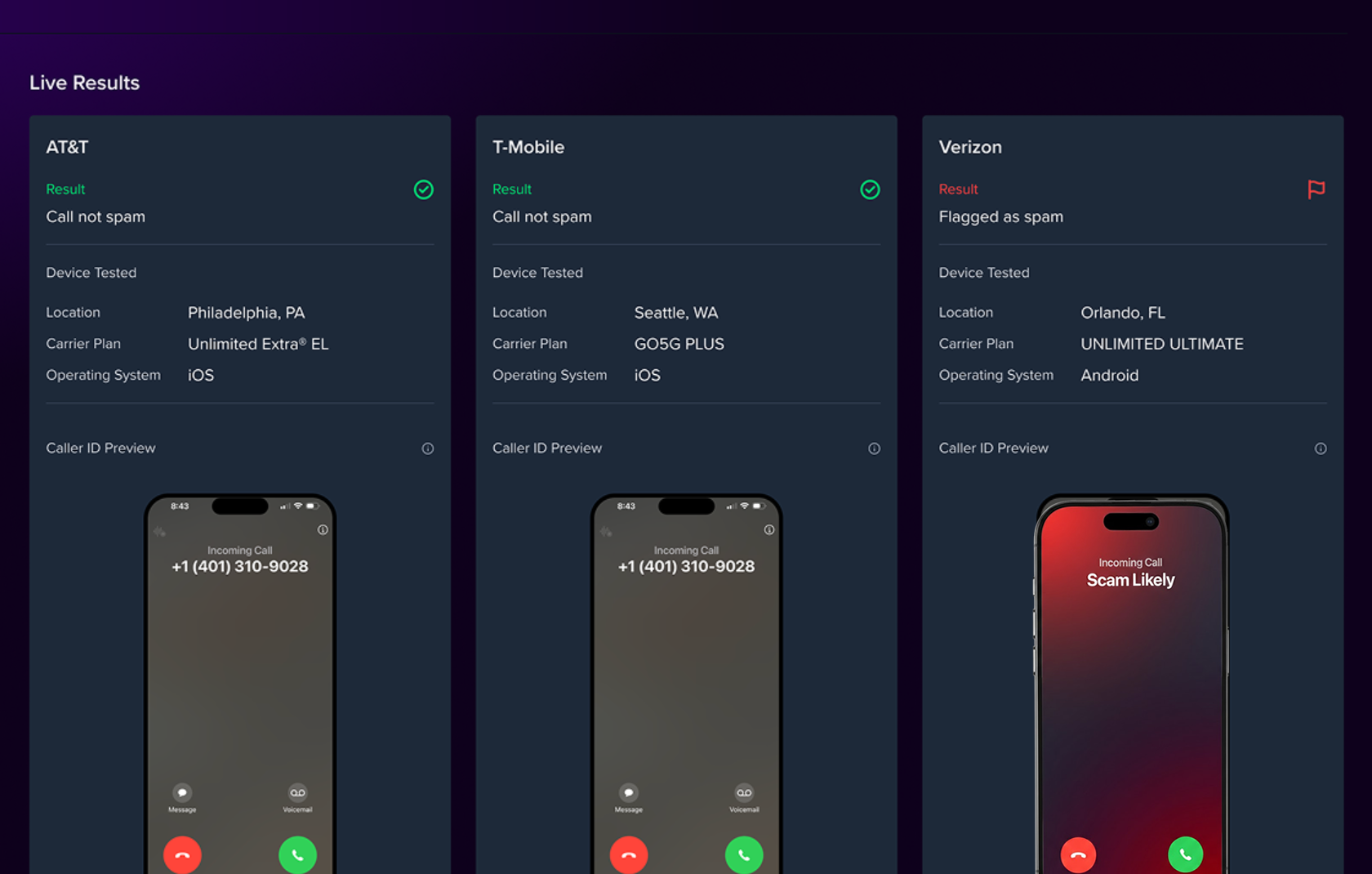
An iPhone, an Android device, or a phone with a call-screening app installed can each display something different. Flags can even vary by geographic location. One data point is entirely insufficient.
Running a spam check is not a one-and-done event. Flags are dynamic — you can be clear at 9am and flagged by noon. Businesses need a repeatable way to check their numbers on an ongoing basis.
Without knowing your number's status across all major carriers, you won't know what to do next.
Here's how to solve all of those issues at once.
A real check does three things:
You can use our spam flag checker to run a free test of your number.
Enter your number and the system places test calls across Verizon, AT&T, and T-Mobile using real subscriber devices. You'll see screenshots of exactly how your call appears on each network when the call is received, including location and device data.
The results tell you whether a flag exists, what the label says, and which carriers are showing it. A flag on one carrier is a different situation than a flag across all three, and knowing the scope is what determines the right next step.
Checking your number once is a start. But most businesses have multiple numbers, and flags can come and go without notice. The businesses that consistently protect their answer rates treat number reputation as an ongoing practice.
The ARMORⓇ service provides ongoing monitoring of your business numbers along with proactive protection, remediation, and expert guidance to help you get ahead of number health issues before they impact your bottom line. Founded by veterans of AT&T, Hiya, and First Orion — the companies that built the systems behind carrier spam detection — ARMORⓇ was purpose-built for businesses that depend on their phones.
Click here to learn more about ARMOR protection.
The most reliable way is to run a multi-carrier spam check using real subscriber devices. You can run a free test at armorhq.com — the system places actual test calls across our nationwide network of Verizon, AT&T, and T-Mobile subscribers and returns screenshots showing exactly how your number appears on each network, including any spam or scam labels. That gives you a complete, accurate picture rather than a guess based on a single test call.
You can’t reliably check if your number is spam without calling. There is no universal list, as labels are dynamic and carrier-specific, meaning they can appear and clear at any time. Placing live test calls across all three major carriers is the reliable way to get a current, comprehensive picture you can act on.
Almost always, no. Carriers have grown wise to number cycling, a tactic frequently used by bad actors, and have responded with algorithm updates that make it counterproductive. New numbers carry higher default risk, and carriers can connect the dots between old, new, and rotated numbers through shared fingerprints like OCN, call path metadata, and STIR/SHAKEN attestation. The right path is to remediate the flag with the carrier and address the underlying factors that contributed to it. Swap without fixing the root cause, and new flags will follow.
Spam flags don't have a fixed duration. Because they are dynamic, real-time classifications rather than entries on a list, they can appear and clear based on ongoing call behavior data. A flag can lift on its own if call patterns improve, or persist and worsen if the underlying behavior continues.
For businesses, waiting for a flag to clear on its own is not a reliable strategy. Active remediation through the carrier, combined with addressing the call behavior patterns that contributed to the flag, is the most effective path to resolving it and preventing its return.
ARMOR® helps businesses monitor and remediate carrier spam flags to protect answer rates and caller reputation.