Average call duration directly affects how carriers evaluate number reputation. A high percentage of short-duration calls is typically associated with unwanted communications, whereas longer calls correlate with wanted conversations. Understanding what's driving short calls and addressing it directly is an actionable way for outbound teams to protect their number reputation. The ARMOR® dashboard can help surface call duration data, along with potential contributing factors to help teams optimize call engagement and reputation signals.
Average call duration is an important number reputation signal that carriers evaluate when determining whether your calls appear wanted by the contacts who receive your calls. Although there are exceptions, longer conversations are often associated with more legitimate outreach by the systems evaluating call activity.
Average call duration isn’t a metric that can simply be forced up; it depends on your contacts wanting to engage with your agents. However, teams can help create the conditions to extend this critical metric by focusing on the right contacts, sharpening their approach, and eliminating the technical and process issues that cut calls short. Call analytics data can help identify where to start.
Carriers and analytics engines evaluate calling behavior across multiple dimensions, and duration is one of the strongest because it serves as a direct proxy for engagement quality. A number that consistently produces calls lasting under 10 seconds (or even shorter) looks very different to a carrier algorithm than one regularly producing calls that last a minute, two, or longer.
A contact who hangs up on the service rep of a legitimate business due to an unclear opening statement and a contact who hangs up on an obvious scam call send the same signal to the analytics engines carriers use to assign spam flags to numbers. The rep's good intent, and even the fact that the contact requested the call don't matter if the call outcomes tell a story similar to that of a bad-faith actor.
That's what makes duration worth paying attention to. It reflects the cumulative quality of your calling operation: who you're calling, your call timing and frequency, and how your reps engage when someone picks up.
Many businesses assume call volume is the primary driver of spam flags, but volume alone is not the problem. High-volume operations run cleanly every day. The real problem is volume in the absence of engagement, and duration is one of the clearest signals of where that gap exists.
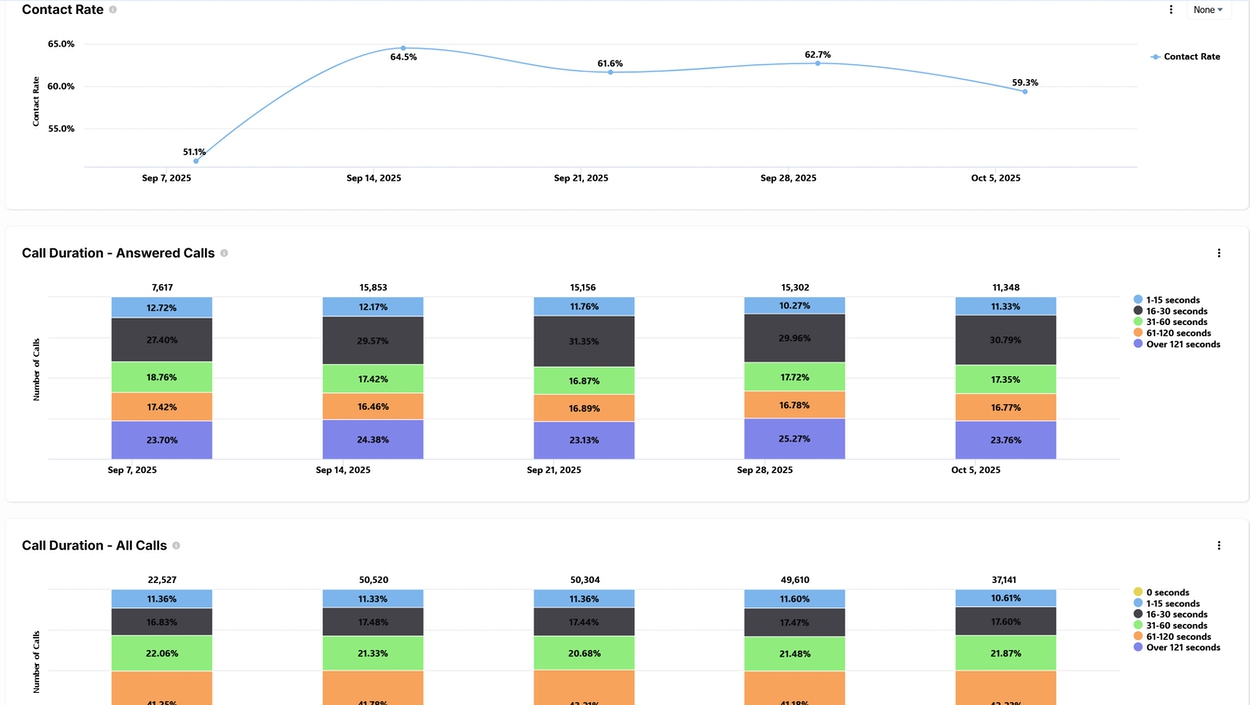
The ARMOR® dashboard gives you access to a range of call duration reports: Total Call Duration, Average Call Duration, Call Duration by Answered Calls, Call Duration by Time of Day, and more. It also provides the ability to filter by number, tags, carrier, and other pivots, so you can track, adapt, and optimize your outbound approach.
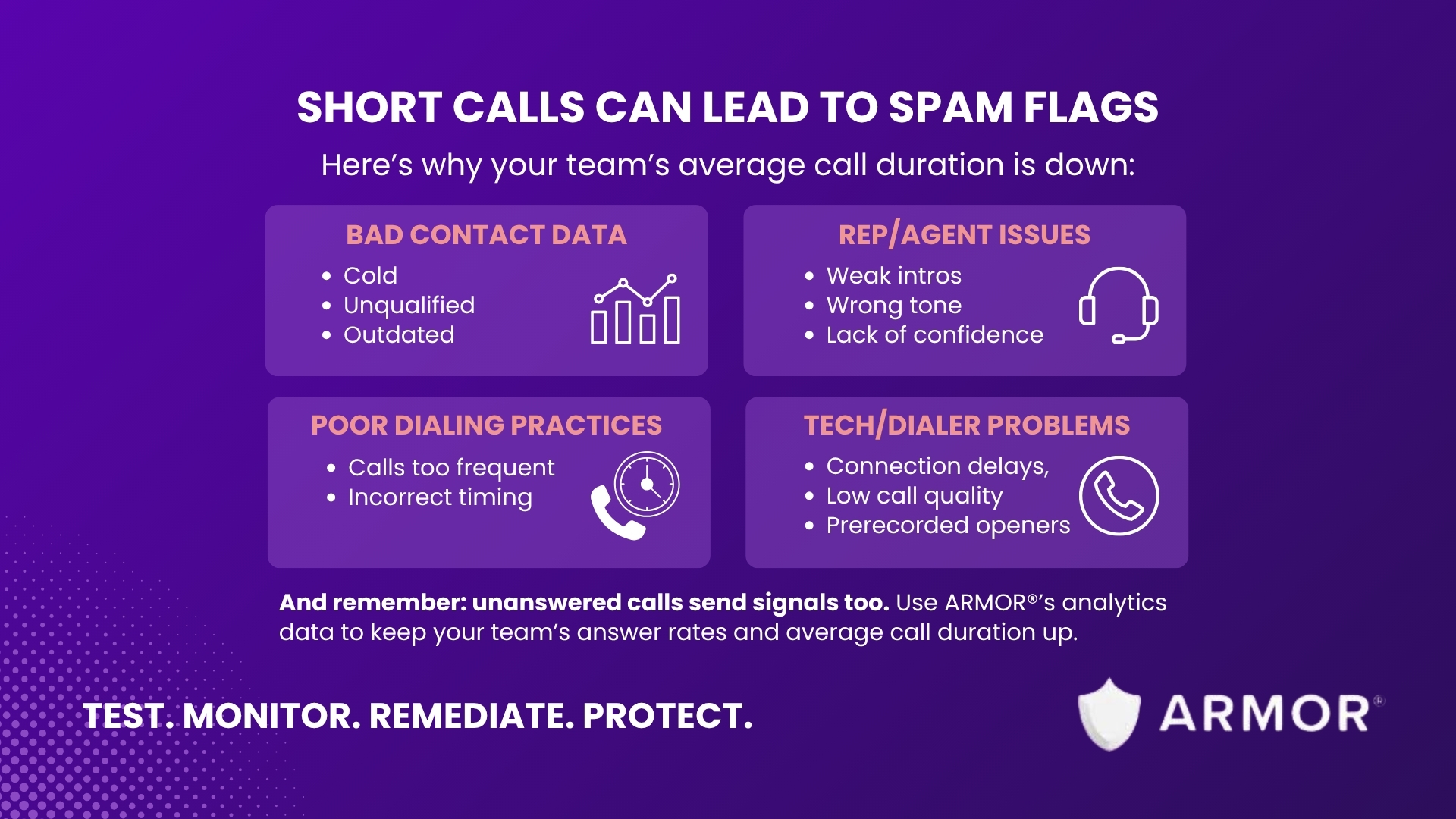
Short-call problems fall into a few distinct categories. Each one produces the kind of low-duration signals that carriers watch for, and most are more fixable than teams realize.
The contacts your reps are dialing have a direct impact on call duration. Calls that don't produce real conversations, for any reason, will shorten call duration.
Contacts with no prior relationship or verified interest are less likely to engage, stay on the line, or recognize why you're calling. The further a contact is from a warm source, the higher the likelihood the call ends quickly.
Disconnected numbers, wrong contacts, and stale records produce calls that either fail to connect or end almost immediately. That's a data hygiene problem, not a calling problem. Regular validation, removing contacts that haven't engaged in a defined window, and avoiding calls to outdated lists is the fix.
Reps can have a lot of influence over call durations. Some reps consistently produce longer calls than others based on differences in training, tone, confidence, and the ability to handle objections in real time.
The first 10 to 15 seconds largely determine whether the conversation continues. If the opener sounds scripted, generic, or irrelevant to the person who answered, they'll hang up. Leading with the reason for the call rather than a formulaic greeting is a good starting point.
Reps who can't navigate pushback effectively lose calls that could have continued. Objection handling is a trainable skill and reps with strong duration numbers can serve as models for those who struggle.
Contacts respond to how a rep sounds, not just what they say. Hesitation, monotone delivery, or an overly aggressive pitch all shorten conversations. Reps who sound confident and conversational hold attention longer.
How and when you call has a direct impact on how long those calls last. Even with a clean list and well-trained reps, poor dialing practices generate short calls.
Calling the same contact too often or too quickly in succession erodes goodwill quickly. Contacts who recognize a number they've already ignored, or who feel harassed by back to back calls are likely to terminate the call before the conversation starts. A cumulative pattern of high-frequency calls against the same contacts will show up in your duration data before it shows up as a flag.
Calling outside of legally permitted hours can subject you to regulatory scrutiny and fines. But even within legally allowed hours, calls placed outside of reasonable blocks - depending on your audience - may lead to more hangups.
Hanging up at voicemail is a missed opportunity on two fronts. It adds a short-duration call to your record with no offsetting engagement signal, and it mimics the pattern robocallers follow. Leaving a voicemail extends call duration and signals that a real person is making a deliberate outreach effort.
Not all short calls are the result of rep performance or list quality. Technical factors introduced by your dialing infrastructure can also cut conversations short.
Predictive and multi-line dialers can introduce a gap between when a contact picks up and when a rep joins the call (or worse, drop the call entirely). That dead-air delay often causes contacts to hang up before the conversation starts. From a carrier's perspective, these are answered calls with near-zero duration, a pattern associated with spam or unwanted communications.
Calls with distorted audio, dropped packets, or inconsistent connectivity cause contacts to disengage quickly. If your infrastructure is producing audio quality issues at scale, it will show up in your duration data.
Automated or prerecorded introductions, even when used by legitimate businesses, can lead to hangups and produce the same short-call pattern as robocallers. Live rep connections produce materially better duration outcomes.
While unanswered calls technically produce no duration, they factor into how analytics systems evaluate your overall call engagement. Consistently low answer rates signal that contacts aren't responding to your outreach, and that pattern is read by carrier systems independently of duration. A number generating high call volume with few conversations to show for it raises the same questions as one producing short calls. The two signals together compound the reputational risk significantly.
Bottom line, call answer rates are critical.
Optimizing call duration starts with keeping your numbers clean. A flagged number suppresses answer rates, and contacts who do pick up are less likely to stay on the line. ARMOR® monitors your numbers across all major U.S. carriers and remediates flags on your behalf, ensuring that the work your team puts into improving call practices isn't undermined by a label your contacts can see and you can't.
For customers with access to call analytics, the dashboard adds another layer: the ability to identify the specific patterns driving short and long call durations, and optimizing strategy accordingly.
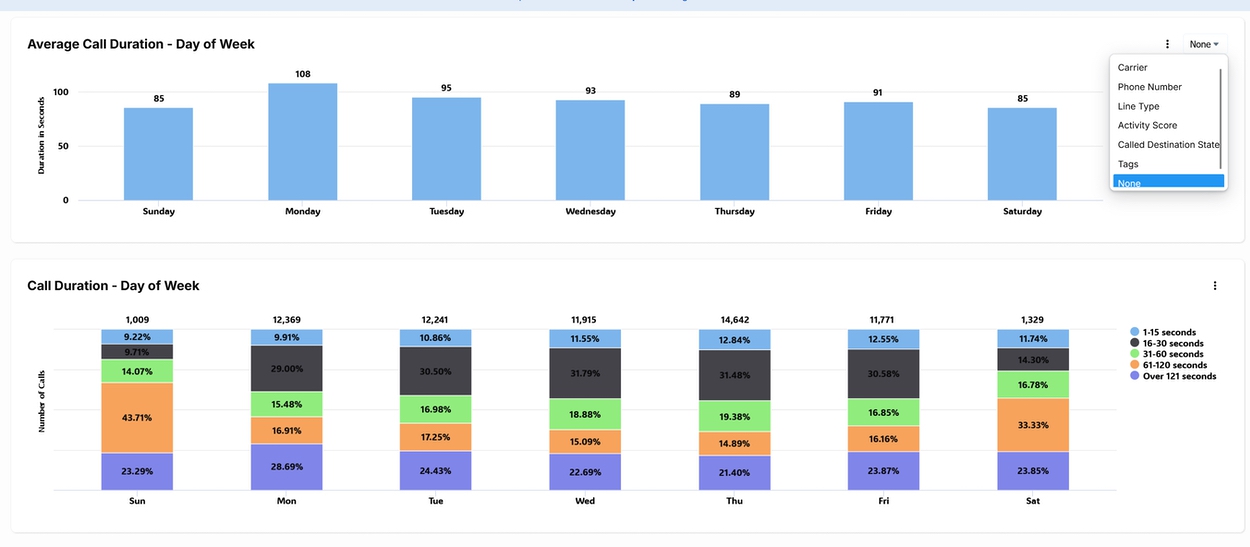
If individual reps (or teams) use a dedicated number or numbers, filtering duration by number gives you a per-rep view of call quality.
Look for outliers on both ends. Reps with consistently short durations may need coaching, script support, or a different contact list, while reps with strong duration numbers can serve as models for everyone else.
This type of filtering is one of the most actionable ways to use the dashboard, and your ARMOR® Customer Success Manager can help you interpret what the data is showing.
The ARMOR® platform allows you to create custom tags that represent sales vs. service teams, regional offices, campaign names, or lead sources. Filtering duration by tag lets you compare engagement quality across different parts of your operation.
Tags also allow you to A/B test approaches, assign different scripts or contact segments, for example, to different tags and compare performance over time. If two sales campaigns targeting similar contacts show very different average durations, that's worth investigating.
Your ARMOR® dashboard enables you to filter all metrics by carrier. If answer rate data on one carrier is consistently lower than on others, it could indicate that your calls are being screened differently on that network or that your CNAM is displaying incorrectly on that carrier's devices. If a carrier flags your numbers while others don't, comparing duration and answer rate on the flagged carrier versus the clean ones can help build the case for remediation.
ARMOR®'s call analytics allow you to A/B test different techniques to optimize your outbound strategy. Change a script, adjust a dial-time window, clean a list segment, or retrain a rep, then check the dashboard a week or two later to see whether the proportion of calls exceeding 60 seconds has shifted. Your ARMOR® Customer Success Manager can help set benchmarks and interpret the results.
Not all calling windows produce the same results. Reviewing duration by time of day and day of week can reveal when your contacts are most likely to engage in a real conversation versus getting off the phone quickly. If certain windows consistently produce shorter calls, that's a signal worth acting on, either by shifting volume to higher-performing windows or investigating whether something specific is driving disengagement at those times.
Duration data accuracy depends on your integration setup. For the most accurate results, ARMOR® offers probe integration, which captures actual call patterns to determine the length of answered calls. For customers providing CDR data where clear answered call data is not available, the ARMOR® team will work with you to establish a call duration threshold that serves as a reasonable proxy for an answered call, factoring in variables like ring time. This is discussed during onboarding to ensure the proxy is calibrated appropriately for your business.
Dashboard access is available on ProtectPlus plans and above. Dedicated Customer Success Manager support is available on ProtectMax.
Call duration is one of the clearest indicators of whether your outbound operation is producing the kind of engagement carriers look for when evaluating your numbers. Short calls aren't just missed opportunities. They're negative signals that accumulate against your numbers over time, increasing your risk of triggering spam flags.
The good news is that duration is largely within your control. Fix weak intros. Invest in rep training. Clean your data. Address issues related to call infrastructure. Then use ARMOR® to track the impact. Your dedicated Customer Success Manager can help you interpret duration trends, compare performance across carriers and reps, and build a plan that strengthens your number reputation over time.