A SIP 603 error indicates that a call was declined, usually by the person you dialed or their device. However, inconsistent carrier behavior has caused 603 to also appear in analytics-based blocking scenarios. To address this ambiguity, the FCC introduced 603+, which explicitly signals that a call was rejected by spam or scam detection systems rather than by the end user.
A 603 (Rejected) error is a common SIP response that signifies a declined call. While it’s typically associated with end-user or device-level rejections, some networks use this same code when they choose not to complete a call, even though SIP 608 was intended for analytics-based blocking. That inconsistency is part of what the FCC’s new 603+ designation aims to fix.
In this guide, we’ll cover what a 603 or 603+ means, why it appears, and what to do when you see it in your outbound calling traffic. Then test your numbers and learn more about the factors that affect the deliverability of your calls.
SIP response codes are three-digit signals that show how a call attempt was processed. They’re part of the Session Initiation Protocol and help indicate whether a call succeeded, failed, or was rejected for some reason.
The 6xx range represents global failures—responses that indicate the call will not be completed. SIP 603/603+ fall into this category, and we’ll break down its meaning in the next section.
In the SIP specification, a 603 (Rejected) response means the call was declined. The request was valid and understood, but the receiving side chose not to accept it.
A 603 is most often associated with end-user or device-level blocking. This includes someone tapping “Decline,” a phone’s built-in spam filter rejecting the call, or on-device settings such as Do Not Disturb.
However, 603 has not always been used consistently. Some networks have used the same code when they choose not to complete a call due to spam concerns, behavior that SIP 608 was originally intended to signal, though 608 was never consistently adopted by carriers.
To reduce this ambiguity, the FCC has introduced 603+, a standardized way for networks to signal that a call was blocked by analytics rather than by the person you dialed. Beginning March 26, 2026, carriers are required to use 603+ when analytics are responsible for the rejection. The 603+ response also includes standardized information so callers know why their call was blocked and how to request remediation.
Learn More: SIP 608 Error – What It Means and How to Interpret It
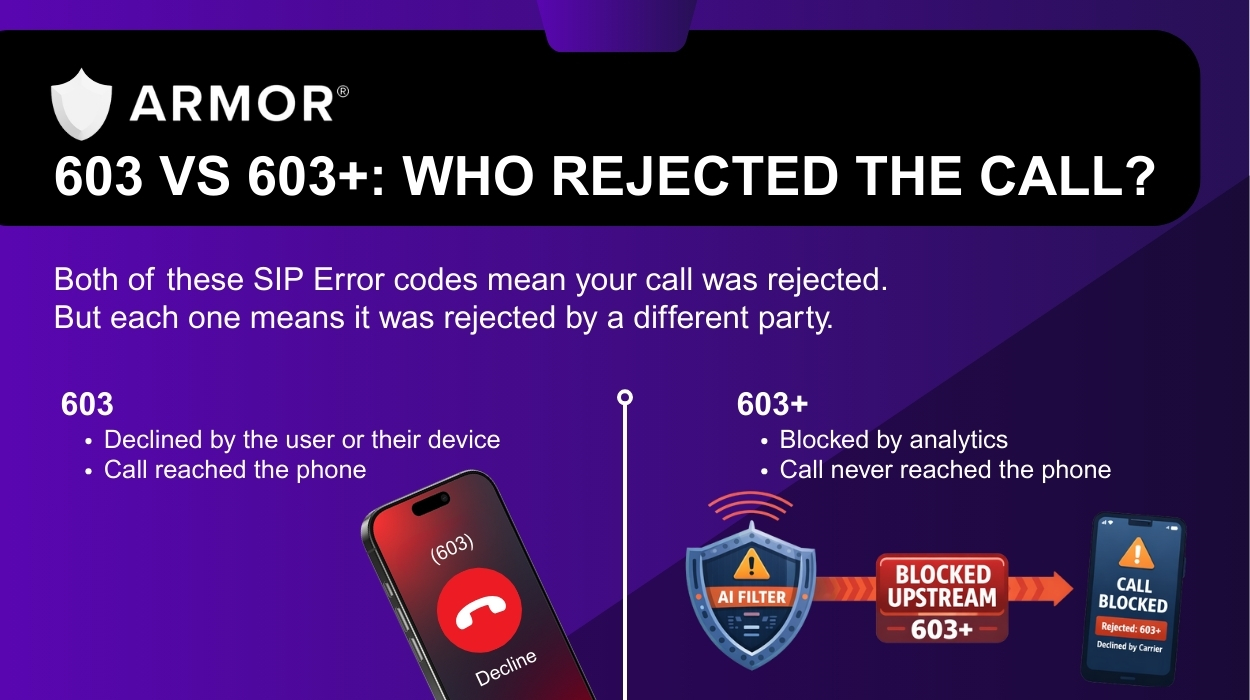
With a standard 603, the decline comes from the person or their device. It’s like calling someone and having them (or their gatekeeper) say, “No thanks, I’m not answering that.”
A 603+, however, tells a different story. It means a spam- or scam-detection system rejected the call before it ever reached the consumer. Think of it like a bodyguard stopping you in the hallway because you looked suspicious, then handing you a note explaining why and who to contact if they got it wrong.
Calls can be rejected for several reasons that produce a 603 or 603+ SIP response. Here are the most common causes:
Learn More: 27 Factors That Can Drive Up Your Spam Flag Risk & How the ARMOR®️ Platform Helps Protect You
Because a 603 can happen for many different reasons, it’s important to look at patterns. A few 603s are normal: people decline calls, phones use Do Not Disturb, and devices block numbers they don’t recognize.
But if you start seeing 603 errors more often than usual, or consistently tied to particular campaigns, lead sources, numbers, carriers, or calling windows, it may be a sign that your calls are being filtered more aggressively. And if you’re receiving 603+ responses, that’s a clear indication that a spam- or scam-detection system made the decision, not the person you dialed.
Understanding which version you’re dealing with (everyday declines or early signs of call filtering) is the first step toward solving the problem.
If you’re seeing repeated 603 or 603+ responses and aren’t sure what’s behind them, we can help you review the patterns and understand what they’re telling you. Whether it’s user blocks or analytics-based filtering, our team can help you identify existing issues, correct them, and prevent future ones.
Let’s turn your 603/603+ SIP errors into 200 OKs:
A SIP 603 means the call was declined. The network received your request, but the person you dialed or their device chose not to accept it. In some cases, certain systems may also return a 603 when they reject the call before it reaches the phone.
A 603+ SIP response indicates the call was rejected by analytics, such as a spam or scam detection system, rather than by the person you dialed. In other words, the call was blocked before it ever reached the device. The FCC requires carriers to use 603+ specifically for analytics-based blocking beginning March 26, 2026.
A standard 603 usually reflects a user or device decline, for example, someone pressing “Decline,” a phone using Do Not Disturb, or a device applying its own blocking rules. A 603+ specifically identifies analytics-based blocking.
Here’s a helpful way to think about it:
SIP 603 is meant for user or device-level declines, while SIP 608 was created for analytics-based blocking, but was never widely implemented. As a result, analytics rejections often showed up under 603 instead, which is a major reason the FCC is requiring the newer 603+ code going forward.
Look at the patterns. Occasional 603s are normal. People are busy, have DND enabled, or simply don’t take unexpected calls. But if 603s start to rise quickly, cluster around specific numbers or campaigns, or appear across multiple caller IDs, it’s a sign of a larger issue that needs to be diagnosed and addressed.
Yes. A 603+ indicates that a carrier’s analytics system deliberately blocked your call before delivery. A single occurrence may be isolated, but repeated 603+ responses almost always indicate a number or calling-pattern reputation problem that needs to be addressed.
Yes. If you can identify the underlying cause of the errors, you can address many of them head-on. User-level declines that go beyond normal “I’m busy” behavior are often influenced by how, when, and whom you’re calling. Potential fixes may include changing call patterns and frequency, improving lead quality, adjusting calling windows, or reviewing number reputation. For 603+, which points to analytics-based blocking, a deeper deliverability and reputation review is usually needed.