A SIP 608 error indicates that a call was rejected by an upstream network or analytics system before it ever reached the person you dialed. Unlike user- or device-level declines, a 608 reflects a deliberate network decision, typically tied to spam or fraud detection. While the code was designed to clearly signal analytics-based blocking, inconsistent carrier adoption has limited its usefulness and led to newer standards like 603+.
A SIP 608 error is one of the clearest signals that a call was stopped before it ever reached the person you dialed. It’s meant to indicate that a network or analytics system made the decision to reject the call, as opposed to the end user. But in real-world dialing, 608s don’t appear as often as the standard suggests, and the same kind of blocking can show up under other SIP codes as well.
This guide explains how 608 works, why it shows up, and how to interpret it alongside your broader deliverability and reputation signals.
SIP response codes are short signals that explain what happened after a call request was sent from your system and received by another network. Each code falls into a general category that helps describe the outcome:
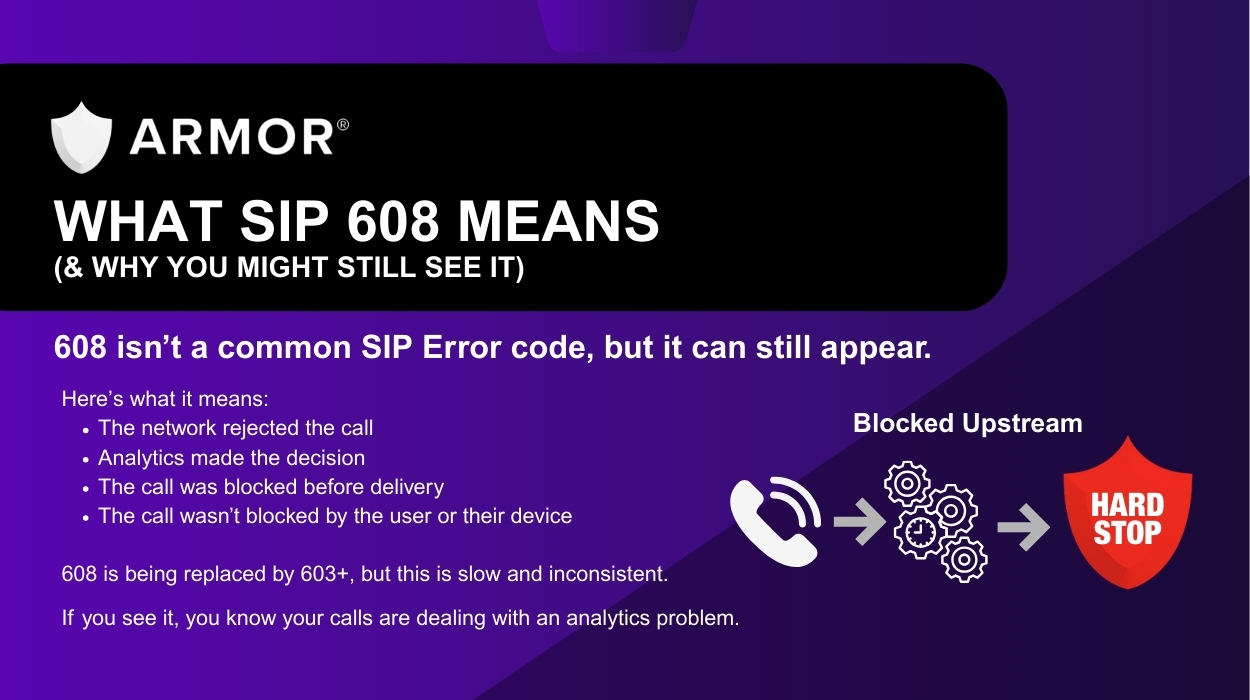
In the SIP standard, a 608 response indicates that the call was rejected by the network before it reached the person you dialed. Unlike a 603, which usually reflects a user or device decline, a 608 is meant to show that an upstream system, typically a spam or fraud analytics engine, made the decision to stop the call.
A 608 tells you that the call request was received, understood, and then blocked entirely. It never reached the device, and the end user never had the chance to answer.
Learn More: 27 Factors That Can Drive Up Your Spam Flag Risk & How the ARMOR®️ Platform Helps Protect You
With a 608, the rejection comes from the network, not the person you dialed.
Think of it like a bodyguard who stops you in the hallway for looking suspicious before you even reach the door.
On paper, SIP 608 should make analytics-based blocking easy to understand. It was created specifically to signal that a network or screening system, not the user, rejected the call.
Unfortunately, most carriers never adopted 608 consistently. In fact, we've seen major carriers return zero 608 responses even in situations where analytics are clearly stopping calls, opting for 403 or 603 instead.
This uneven adoption has made 608 far less useful as a diagnostic signal. It’s also a big reason the FCC introduced the newer 603+ standard, which is designed to give callers a clear, consistent indication when analytics block the call.
Whereas the 608 response never included standardized redress information, limiting its usefulness for callers trying to resolve improper blocking, 603+ is required to do so.
Learn More:
If you look at how these codes were designed, and how they’re actually used, it becomes clearer why 608’s value is limited. Here’s the real-world landscape:
In short, 603+ is designed to replace 608 by eliminating the inconsistency and ambiguity in how analytics-based blocking is reported.
Because 608 is used so rarely, seeing it at all usually means one thing:
an analytics system made an active decision to block your call.
That’s why recurring 608 responses are a red flag. They almost always point to a broader reputation or deliverability issue, something in your calling patterns, number reputation, or traffic behavior is triggering a network-level filter.
At this point, it’s worth reflecting on your call practices, reviewing contact lists for quality, accuracy, and relevancy, and exploring a number reputation solution.
It's important to note, that because so few carriers use 608 consistently, similar problems may surface as 603, 603+, or even 403 errors. While this ambiguity is unfortunate, the FCC's required adoption of 603+ in 2026 should put an end to it.
Learn More: Call Reputation Management Services: Are They Worth It?
If you’re seeing recurring 608 responses and aren’t sure what’s causing them, our team can help interpret the patterns, diagnose the issue, and outline a plan to fix it. Our deep understanding of the spam- and scam-flag ecosystem, combined with long-standing carrier relationships, makes us an ideal ally in identifying mislabeled calls and restoring healthy call delivery.
Let’s turn your 608 SIP errors into 200 OKs:
A SIP 608 means your call was rejected by an upstream analytics system, such as a spam or fraud detection engine, before it reached the person you dialed. It is a network-level block, not a user decline, and reflects a decision made by a carrier or analytics provider.
Some carriers rarely return a 608 SIP response, and others never do. Even when analytics clearly stop a call, many networks return different codes, often 403 or 603. This inconsistency prompted the FCC to require the use of 603+ to designate spam/scam analytics filtering, effective March 26, 2026.
To some degree, yes. A 608 means an analytics engine blocked your call. One 608 may be isolated, but repeated 608s (or 603+ signals) point to a reputation issue that should be addressed. While the SIP response doesn’t tell you exactly why the call was blocked, the ARMOR® service can help provide this clarity and help you take steps to fix it.
Yes, by addressing the conditions that caused the analytics block. Improving call reputation often includes refining call patterns and frequency, reviewing lead quality and accuracy, and remediating false spam flags. Solutions like the ARMOR® service can help protect your numbers, detect emerging issues, and remediate unwanted spam labels so your calls get delivered consistently.