Outbound calling must now account for tighter FCC rules, including stricter STIR/SHAKEN enforcement and expanded Robocall Mitigation Database obligations. This makes it essential for outbound teams to become more deliberate about how they place calls and more informed about how those calls are treated. Monitoring outbound numbers, taking steps to improve number reputation, and maintaining dialing integrity via consistent practices and accurate caller identification data help teams protect deliverability and connect more effectively on calls.
Outbound calling still works. But the environment around how calls are evaluated, delivered, and answered keeps evolving.
Over the last year, the pressure has increased at the carrier and infrastructure level. FCC enforcement around caller authentication and provider database obligations has tightened, while carriers continue using analytics and blocking tools to keep illegal traffic off their networks.
For outbound teams, the practical takeaway is not to stop calling. It is that call integrity and visibility into call treatment matters more than it ever has.
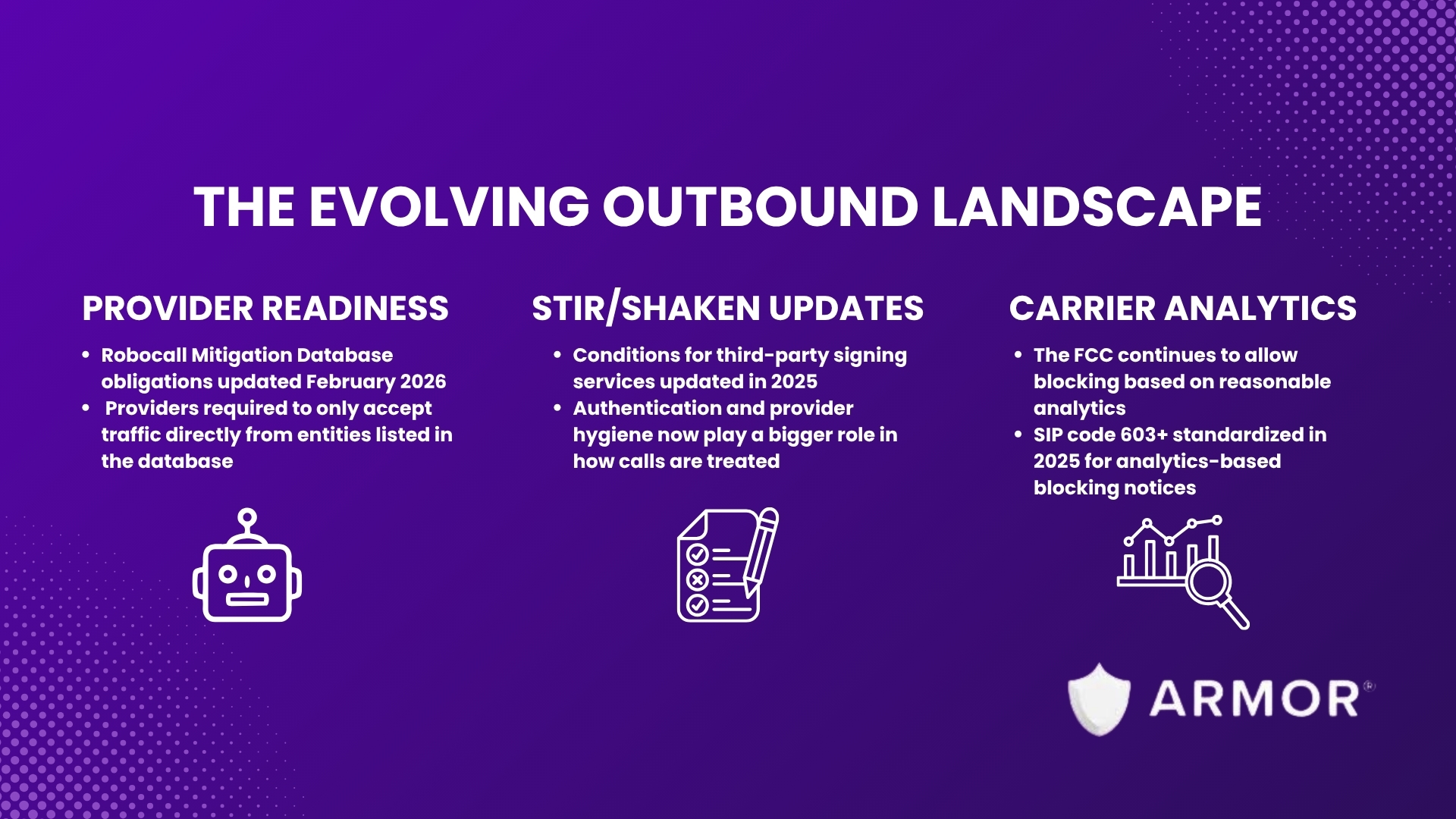
In early 2026, the FCC put revised Robocall Mitigation Database rules into effect, opened the annual recertification window, and established a mechanism for reporting deficient filings. These changes have made provider readiness and call-path visibility more important for outbound teams.
STIR/SHAKEN has been a regulatory requirement for major carriers since 2021, but its enforcement expectations have continued to evolve. The FCC describes it as a major tool for verifying that caller ID information matches the caller's number, and has said that STIR/SHAKEN data supports service providers and call blocking and labeling applications.
The framework assigns attestation levels to calls:
Carriers use these levels alongside other signals to identify potential calling spoofing, using attestation as a level of confidence that the calling party is the number's rightful owner. A lower attestation level doesn't automatically result in a spam flag, but it reduces the trust a receiving carrier assigns to the call, making it more vulnerable to filtering.
Related: Best Practices to Prevent Your Calls From Being Flagged
The FCC also tightened rules around third-party STIR/SHAKEN signing, with compliance required in September 2025. For outbound teams, that does not mean becoming experts in the rulebook. It means recognizing that authentication and provider hygiene now play a bigger role in how calls are treated across the ecosystem.
The FCC has expanded the Robocall Mitigation Database obligations, required providers to accept traffic only directly from entities listed in the database, and removed more than 1,200 providers for noncompliant filings in 2025. When that happens, downstream providers must stop accepting traffic from those companies.
The operational takeaway is straightforward: a weak link anywhere in your provider path can become a deliverability issue, even when nothing has changed in your campaign or on your team.
The FCC continues to allow blocking based on reasonable analytics and, in 2025, standardized SIP code 603+ for analytics-based blocking notices. The FCC's transparency and redress rules exist because legitimate calls can be blocked in error.
In practice, that means a sudden drop in performance is not always a list problem, a rep problem, or a messaging problem. Sometimes it is a call-treatment problem that is invisible unless you know where to look.
The FCC has discussed richer caller identity and proposed verified caller-name requirements, but has not made caller-name display a current mandate.
The right takeaway is not that a new requirement has suddenly arrived. It is that the broader ecosystem is moving toward more verified, more trustworthy caller identity, which makes consistency in how your numbers and caller information appear increasingly important.
For outbound teams, this changes the operating model more than the mission. High-performing teams are not abandoning calling.
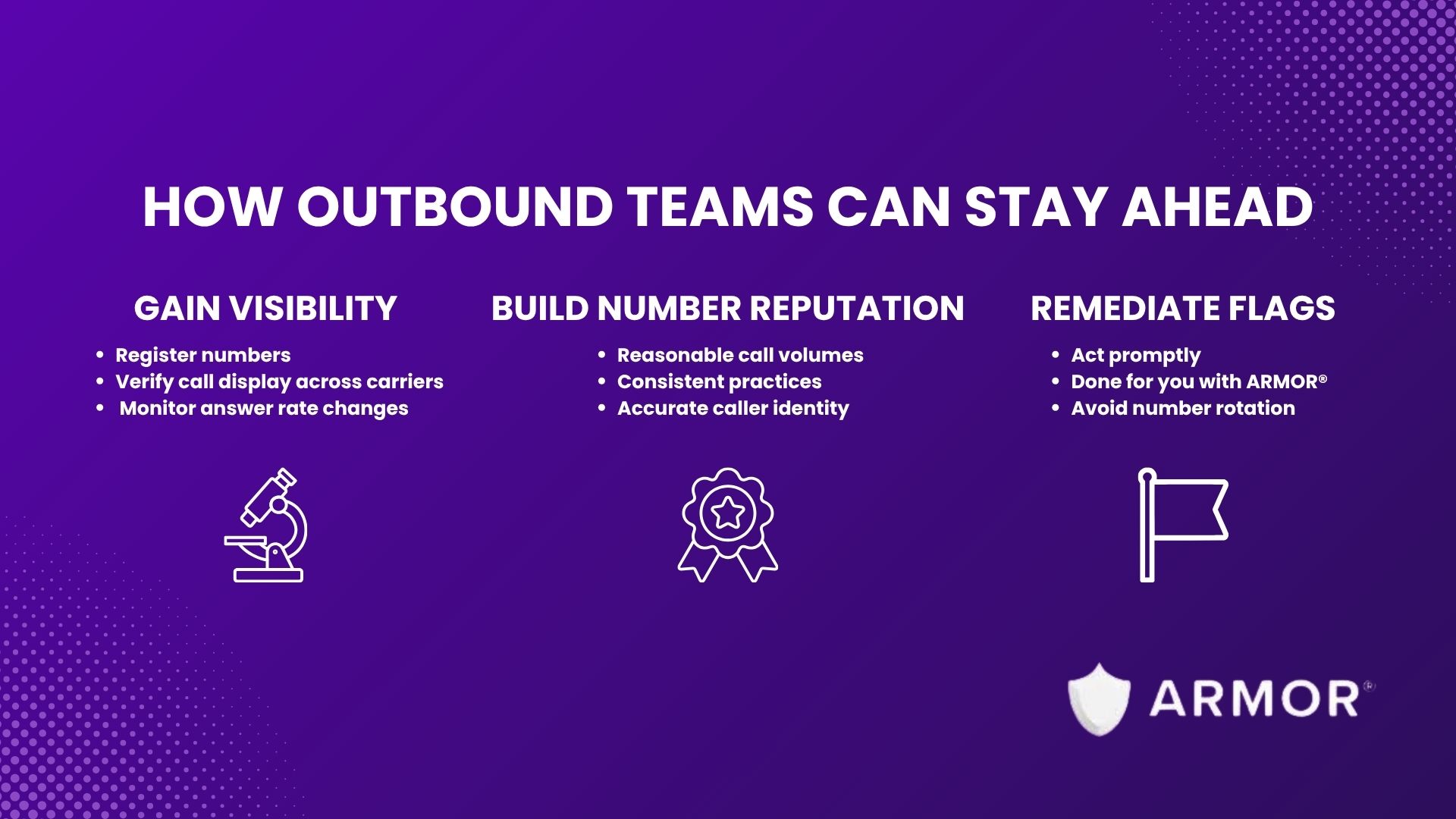
Teams want to know how their numbers display across carriers, whether performance is shifting by carrier or region, whether provider-side issues may be affecting traffic, and whether a drop in answer rates points to a treatment issue before it becomes a bigger problem. That kind of visibility used to be a nice-to-have. In today's environment it's the difference between catching a problem early and inheriting one.
How you dial matters as much as how often you dial. Building and maintaining the reputation of specific numbers through reasonable call volumes, consistent practices, and accurate caller identity is increasingly what determines whether your calls get through.
One thing worth noting on number management: rotation (the practice of cycling through numbers to escape flags) is not a reliable fix.
Carriers and analytics firms can increasingly track rotation patterns, and are adept at connecting the dots when organizations rotate numbers to spread out bad behavior. They treat this as a signal of problematic dialing behavior, which can compound the underlying issue. The right approach is consistent practices and prompt remediation when false flags appear.
Learn More About Why Number Rotation Doesn’t Work.
ARMOR® is not a compliance solution, and it does not replace legal guidance. Its role is operational: giving teams better visibility into how their calls are being treated, helping them catch issues earlier, and supporting a faster, more informed response when something changes.
In a more complex calling environment, that kind of visibility matters. The teams that perform most consistently are not the ones guessing their way through answer-rate changes. They are the ones with a clearer view of what is happening and a better process for optimizing number reputation and calling patterns for sustainable success.
Outbound calling is still a strong channel. In 2026, integrity, consistency, and visibility are what separate stable performance from avoidable disruption.
Get a demo of ARMOR® today and see how improving your number reputation changes the way your teams reach the people they're calling.
This article is for general informational purposes and does not constitute legal advice. Consult qualified legal counsel for guidance on TCPA compliance, state telemarketing laws, and data privacy obligations.